Compliance

Worked examples, with every step shown.

Five calculations: a true PlutoHX girth flange calculation to Appendix 2, and four teaching examples on a shell like the reference one, each with its formula, inputs, steps, and result.

The examples

From the flange to a change of design pressure.

01

The girth flange and its bolting

Mandatory Appendix 2

Am = max(Wm1 / Sb, Wm2 / Sb)

G
42.38 in. Gasket reaction diameter
P
464 psi. Design pressure
b
0.25 in. Effective gasket width, equal to b0 as b0 is not over 1/4 in
m, y
3 and 10,000 psi. Gasket factor and seating stress
Sb
25,000 psi. Allowable bolt stress, operating and seating
  • H = (π/4) G² P = 654,400 lbf
  • Hp = 2 b π G m P = 92,650 lbf
  • Wm1 = H + Hp = 747,000 lbf
  • Wm2 = π b G y = 332,800 lbf
  • Am = 747,000 / 25,000 = 29.88 in²
Required bolt area, Am29.88 in²
Provided, 60 × 1 in bolts33.06 in²
Flange thickness1.875 in

A true PlutoHX calculation, from the girth flange example. With 60 bolts of 7/8 in, the 25.14 in² provided is below the required area; 72 bolts of 7/8 in give 30.17 in² and meet the requirement again.
02

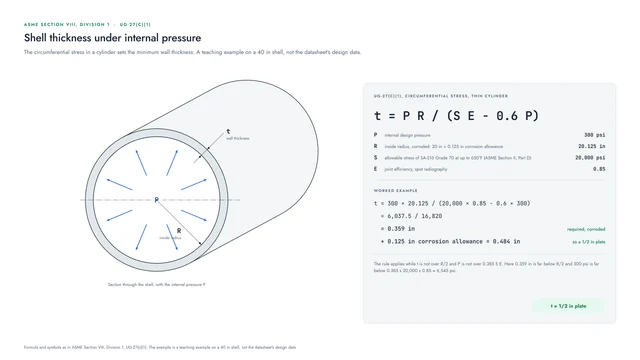
Shell under internal pressure

UG-27(c)(1)

t = P R / (S E - 0.6 P)

P
300 psi. Internal design pressure
R
20.125 in. Inside radius: 20 in plus the 0.125 in corrosion allowance
S
20,000 psi. Allowable stress, SA-516 Grade 70, ASME Section II, Part D, up to 650°F
E
0.85. Joint efficiency, spot radiography
  • t = 300 × 20.125 / (20,000 × 0.85 - 0.6 × 300)
  • t = 6,037.5 / 16,820
  • t = 0.359 in
Required thickness0.359 in
Plus corrosion allowance0.125 in
Total0.484 in
Plate1/2 in

The rule applies while t is not over R/2 and P is not over 0.385 S E.

03

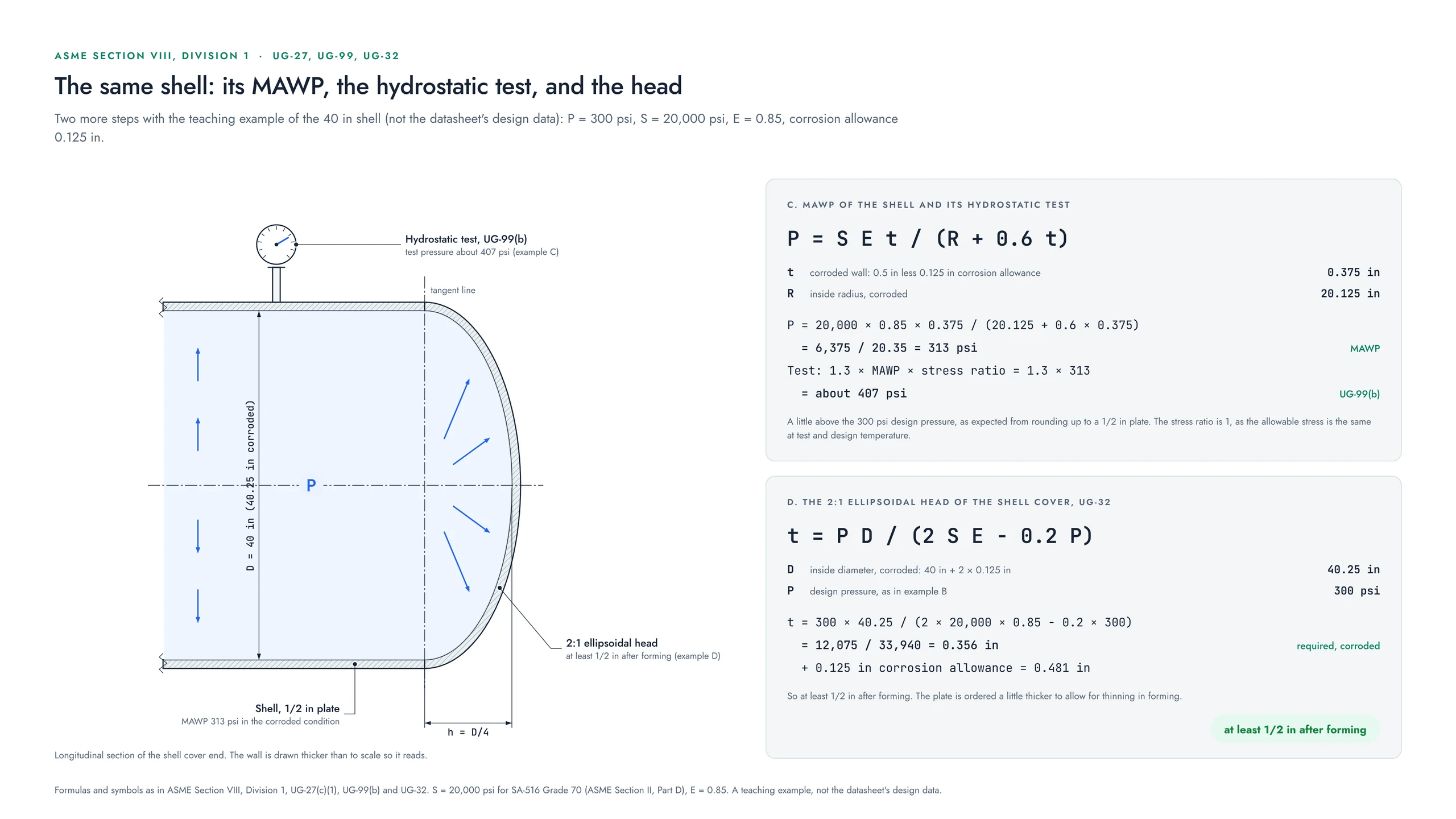
The MAWP of that shell, and its hydrostatic test

UG-27(c)(1), UG-99(b)

P = S E t / (R + 0.6 t)

t
0.375 in. The 1/2 in plate less the 0.125 in corrosion allowance (corroded condition)
R
20.125 in. Inside radius, corroded
S
20,000 psi. Allowable stress, as before
E
0.85. Joint efficiency, as before
  • P = 20,000 × 0.85 × 0.375 / (20.125 + 0.6 × 0.375)
  • P = 6,375 / 20.35
  • MAWP = 313 psi
MAWP313 psi
Design pressure300 psi
Hydrostatic test, 1.3 × MAWPabout 407 psi

The MAWP is a little above the 300 psi design pressure, as expected from rounding up to a 1/2 in plate. The hydrostatic test to UG-99(b) is at least 1.3 × MAWP × the stress ratio; with the same allowable stress at test and design temperature the ratio is 1.

04

The 2:1 ellipsoidal head of the shell cover

UG-32

t = P D / (2 S E - 0.2 P)

P
300 psi. Internal design pressure
D
40.25 in. Inside diameter, corroded: 40 in plus 2 × 0.125 in
S
20,000 psi. Allowable stress, as before
E
0.85. Joint efficiency, as before
  • t = 300 × 40.25 / (2 × 20,000 × 0.85 - 0.2 × 300)
  • t = 12,075 / 33,940
  • t = 0.356 in
Required thickness0.356 in
Plus corrosion allowance0.125 in
Total0.481 in
After formingat least 1/2 in

The plate is ordered a little thicker than 1/2 in, to allow for thinning in forming.

05

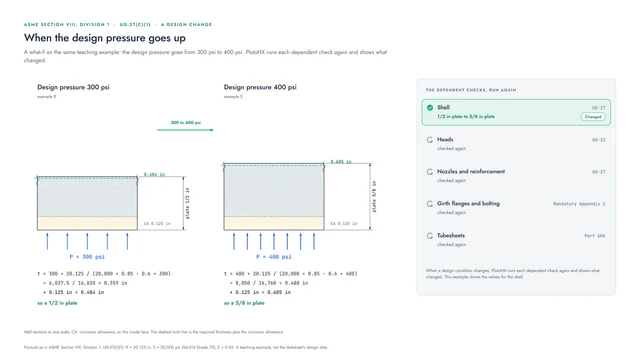
A design change: the same shell at 400 psi

UG-27(c)(1)

t = P R / (S E - 0.6 P)

P
400 psi. The new design pressure
R
20.125 in. Inside radius, as before
S
20,000 psi. Allowable stress, as before
E
0.85. Joint efficiency, as before
  • t = 400 × 20.125 / (20,000 × 0.85 - 0.6 × 400)
  • t = 8,050 / 16,760
  • t = 0.480 in
Required thickness0.480 in
Plus corrosion allowance0.125 in
Total0.605 in
Plate5/8 in

When a design condition changes, PlutoHX runs the dependent checks again (shell, heads, nozzles, flanges and bolting, and tubesheets) and shows what changed. Here the shell goes from a 1/2 in to a 5/8 in plate.

About these examples

Where the values come from.

Example 1 is the girth flange calculation that PlutoHX makes for the reference exchanger. Examples 2 to 5 are teaching examples: they use a 40 in shell of SA-516 Grade 70 with a 0.125 in corrosion allowance, and they are not the design data of HX-123.

Coming Winter 2026

We would be glad to show you PlutoHX.

PlutoHX launches at the end of this year. A live demo shows how it fits the way your team works.

Book a demo

We would be glad to walk your team through PlutoHX, live.

Book a demo

Ask us a question

You are welcome to write to sales@plutohx.com or call +1 (713) 562-0368 with any question about PlutoHX.

Contact us

Visit us at the booth for a deep dive into PlutoHX.

sales@plutohx.com+1 (713) 562-0368Contact