
Feature
The datasheet comes in directly.
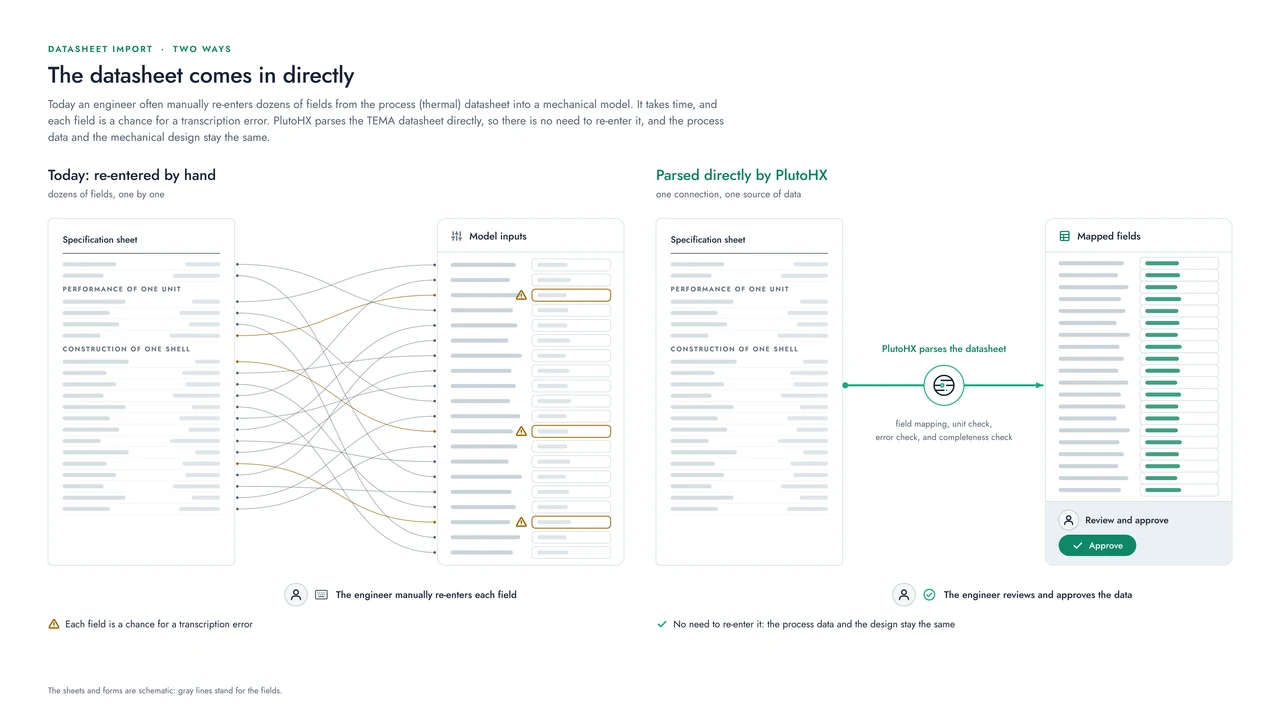
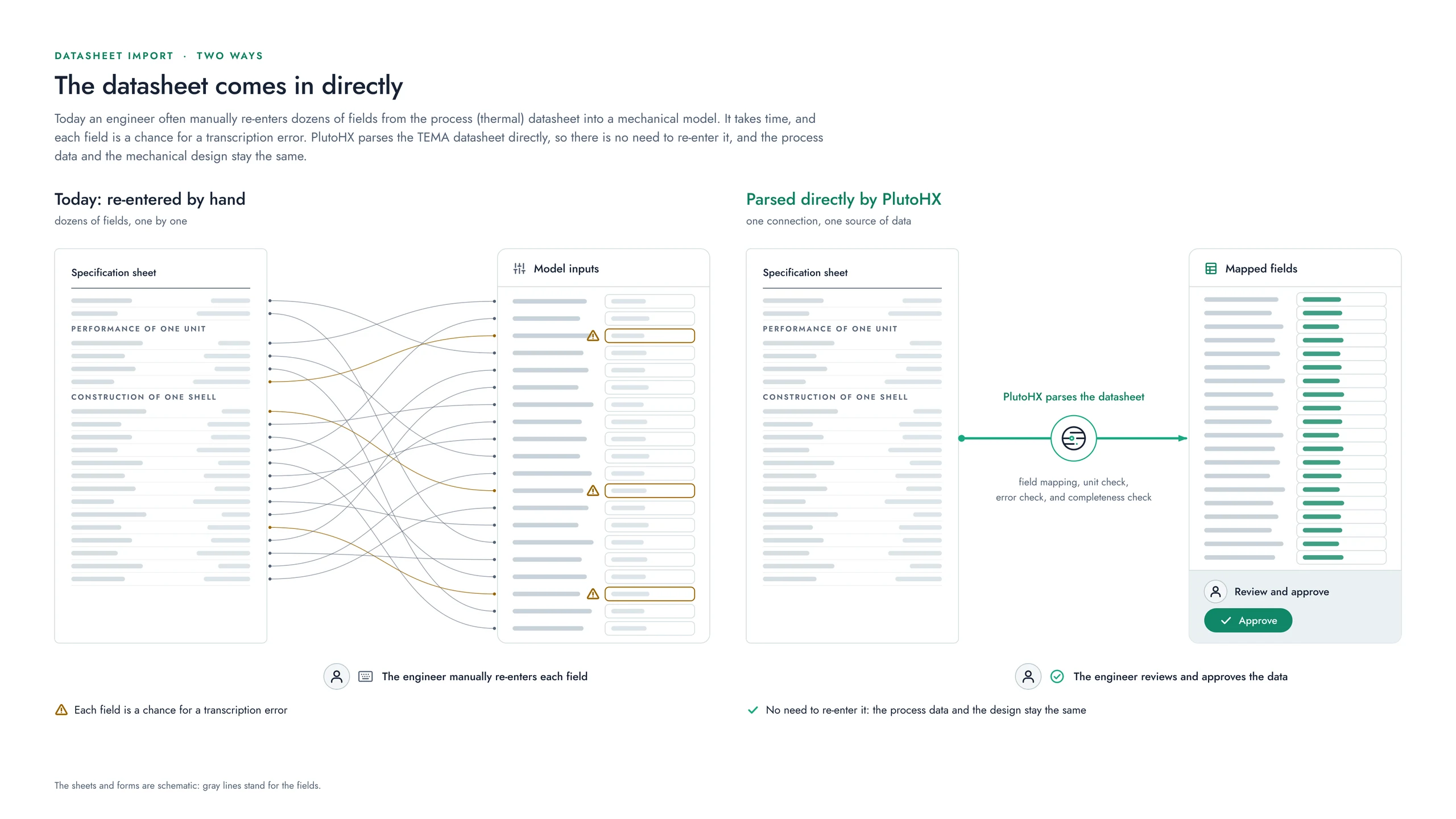
PlutoHX parses the process datasheet from your thermal design, so there is no need to enter it again, and the process data and the mechanical design stay the same.
Why it matters
One source for the process data.
Manually re-entering each value from the thermal datasheet into a mechanical model is slow, and every value entered by hand is one more chance for a transcription error. When the datasheet is parsed directly, the values in the mechanical design are the values the process engineer wrote.
How it parses
From the sheet to the design data.
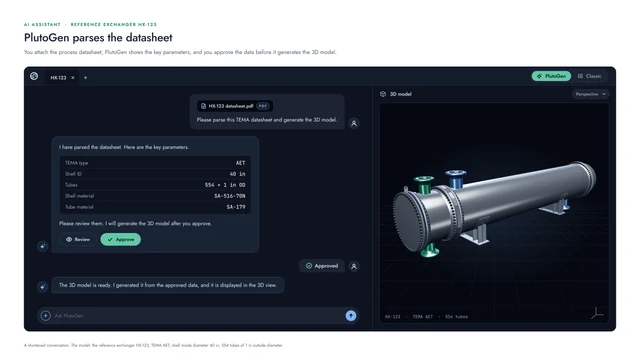
You add the TEMA datasheet as a PDF or an image. PlutoHX finds the fields for the shell geometry, the tube bundle, the nozzles, and the baffles, then maps each one, checks its units, looks for errors, and checks that nothing is missing.
When it has finished, the open items are listed by area (general options, process conditions, structural loads, geometry, and connection details), with a count of the action items left.
Datasheet flags
What the datasheet leaves blank.
Some values a mechanical design needs can be blank on a TEMA datasheet. After parsing, PlutoHX lists the items the sheet leaves blank, each with its datasheet line. PlutoGen proposes standard values for them, and the engineer reviews them before the design proceeds.
- The minimum radiography requirement
- Whether PWHT (post-weld heat treatment) is required
- Nozzle rating, type, and facing
- The number of cross baffles
- The support type and the number of supports
- Girth flanges, gaskets, and nozzle necks
- External and internal bolting
The data
What PlutoHX takes from the datasheet.
| Area | Data |
|---|---|
| General | Design pressure (S, T); design temperature (S, T); operating pressure (S, T); operating temperature (S, T); corrosion allowance (S, T); joint efficiency; MDMT (S, T); design code (ASME Section VIII, Division 1); TEMA class (R, C, or B) |
| Front head | Channel type (A, B, C, D, N); channel material; front tubesheet details; tube-to-tubesheet joint; front head nozzles; flange rating |
| Shell | Shell inside diameter and length; material; orientation (horizontal or vertical); shell type (E, F, G, H, J, K); nozzles (size, orientation, number); nozzle flanges and reinforcing pads; saddle supports and their spacing |
| Tube bundle | Number, length, outside diameter, pitch, and layout of the tubes; material; baffles (orientation, cut, spacing, number); impingement plate or rods; spacer rods; support plates |
| Rear head | Rear head type (L, M, N, P, S, T, U, W); material; floating head or bonnet details; expansion joint (if any); tubesheet details; rear flange; rear head nozzles |
S is the shell side and T the tube side. MDMT: minimum design metal temperature.
You review before anything is designed
Each imported value is shown for review. You verify it, confirm the assumptions, and add or update what is needed, and then PlutoHX designs the exchanger.
Coming Winter 2026
We would be glad to show you PlutoHX.
PlutoHX launches at the end of this year. A live demo shows how it fits the way your team works.
Visit us at the booth for a deep dive into PlutoHX.