
Guide
TEMA type letters explained.
Three letters, read from the front of the exchanger to the rear, say a great deal about how it is built.
The order
Front end, shell, rear end.
The first letter names the front end (stationary head), the second the shell, and the third the rear end. Each position has its own set of letters, so the same letter can mean different things in different places: N, for example, is both a front end and a rear end.
On the reference exchanger
A, E, and T, where they sit.
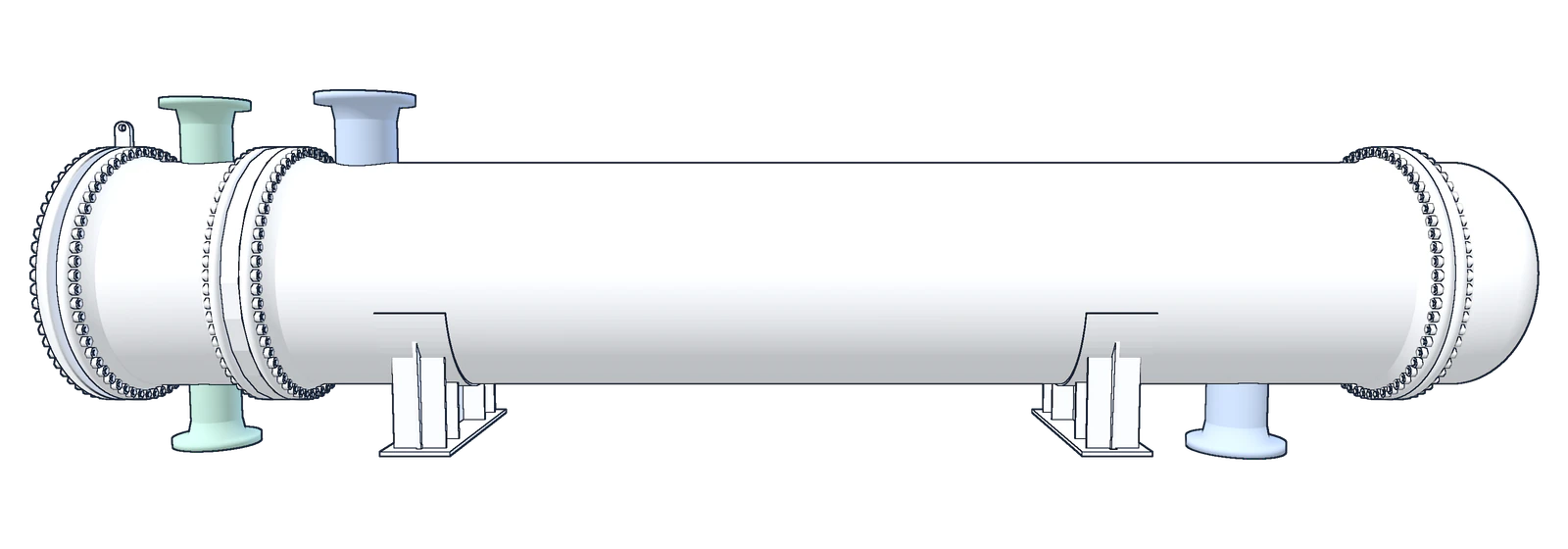
- Front end. A: channel and removable cover
- Shell. E: one pass shell
- Rear end. T: pull-through floating head
Two examples
AET and AES.
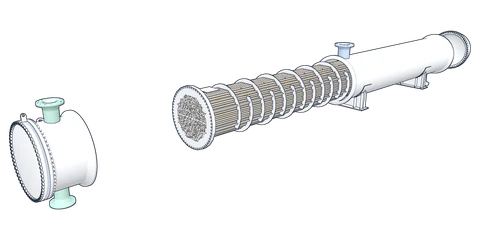
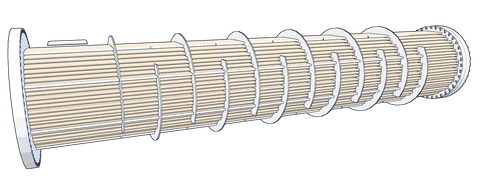
The reference exchanger is an AET. Its channel has a removable cover (A), its shell is a single pass (E), and its bundle ends in a pull-through floating head (T).
The example that PlutoGen is given on its page asks for an AES: the same front end and shell, with a floating head with a backing device (S) at the rear.
The last letter
What the rear end letter tells you.
The rear end letter shows how the tube bundle is held. L, M, and N belong to fixed tubesheet exchangers, U to U-tube bundles, and P, S, T, and W to floating head designs.
The full chart
Every letter of each position, with its name and the nomenclature drawing.
Coming Winter 2026
We would be glad to show you PlutoHX.
PlutoHX launches at the end of this year. A live demo shows how it fits the way your team works.
Visit us at the booth for a deep dive into PlutoHX.