
Resources
Questions and answers.
The questions engineers ask us most often, about PlutoHX and about the rules behind it.
About PlutoHX
What is PlutoHX?
Mechanical design software for shell-and-tube heat exchangers, to ASME Section VIII, Division 1, TEMA, and API 660. It parses the process datasheet, you approve the data, and it designs the exchanger, shows it in 3D, and writes the calculation package.
Product overviewHow is it different from thermal design software such as HTRI or Aspen EDR?
Thermal design software sizes the exchanger for the process: heat duty, heat transfer coefficients, pressure drops, the shell size, and the tube details. PlutoHX does the mechanical design that follows: thicknesses, loads and stresses, flanges and bolting, and tubesheets and supports, checked to the codes. It starts from the specification sheet the thermal design produces.
What does PlutoHX need to start?
The process datasheet, or the same data typed or described: design pressures and temperatures, operating conditions, corrosion allowances, materials, geometry, heads, nozzles, supports, loads such as wind and seismic, and the design code; for an exchanger also the tube bundle, tubesheets, baffles, and channel.
The data PlutoHX takes from the datasheetDoes PlutoHX make the decisions for me?
No. You review and approve the data before any design is made, and every result shows its formula, inputs, and code reference, so you can check it.
How it worksWhich exchanger types?
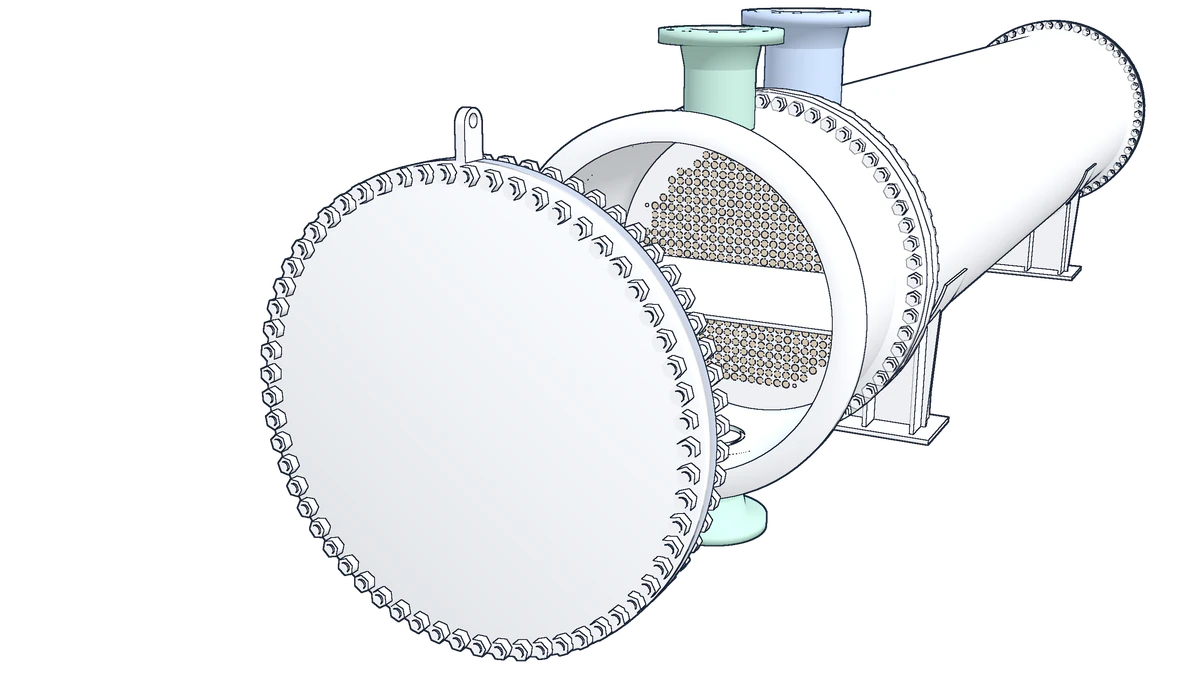
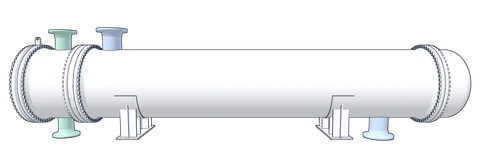
Fixed tubesheet, U-tube, and floating head (including split ring and lantern ring designs); all TEMA front end, shell, and rear end types.
Exchanger typesWhich reports do I get?
The calculation package (PDF and Excel), general arrangement drawings, the bill of materials and material weight, NDE and PWHT requirements, and software validation.
ReportsMetric or imperial?
Both; you choose in the settings.
When is PlutoHX available?
It is coming in Winter 2026. We would be glad to explain it to you: visit us at the booth for a deep dive into PlutoHX, or write to sales@plutohx.com.
Book a demoIs there a free plan?
Yes: the Free plan is for engineering colleges, professionals with less than five years of experience, and companies that want to try PlutoHX.
PlansAbout the codes
Which ASME rules cover the heads?
Formed heads (hemispherical, 2:1 ellipsoidal, torispherical): UG-32. Flat heads and covers: UG-34. External pressure: UG-28 to UG-30. Openings and reinforcement: UG-36 to UG-45. Allowable stresses: ASME Section II, Part D. Joint efficiency: UW-11 and UW-12.
ASME Section VIII, Division 1What kinds of tube-to-tubesheet joint are there?
Expanded; expanded and seal welded; strength welded. The rules come from ASME Part UHX, TEMA, and ASME Section IX for welding procedures and welder qualification; ASME Section VIII, Division 1, UW-20 covers tube-to-tubesheet welds.
TubesheetsWhat is MAWP?
The maximum allowable working pressure: the highest pressure the equipment may see at its design temperature under the code. The worked examples page works it out for the teaching shell.
Worked example 3What is MDMT?
The minimum design metal temperature: the lowest metal temperature for which the design is safe against brittle fracture (UCS-66 for carbon steels).
Why a corrosion allowance?
Extra thickness added to the calculated thickness, so the part stays strong enough after the metal lost to corrosion or erosion over its life (ASME Section VIII, Division 1, UG-25).
What is joint efficiency?
A factor for the quality of a welded joint, set by the type of joint and how much of it is radiographed (UW-12); for example 0.85 with spot radiography, as in the shell example.
Worked example 2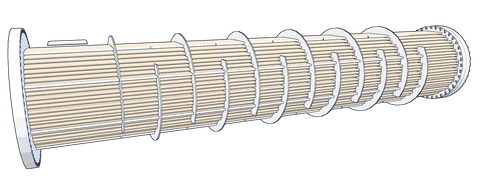
Coming Winter 2026
We would be glad to show you PlutoHX.
PlutoHX launches at the end of this year. A live demo shows how it fits the way your team works.
Visit us at the booth for a deep dive into PlutoHX.